At Home in the Levant, plate 4 of 25
Energy: Power, Heat, and Resilience
Harvest together. Store wisely. Keep essential systems running.
The plate in brief
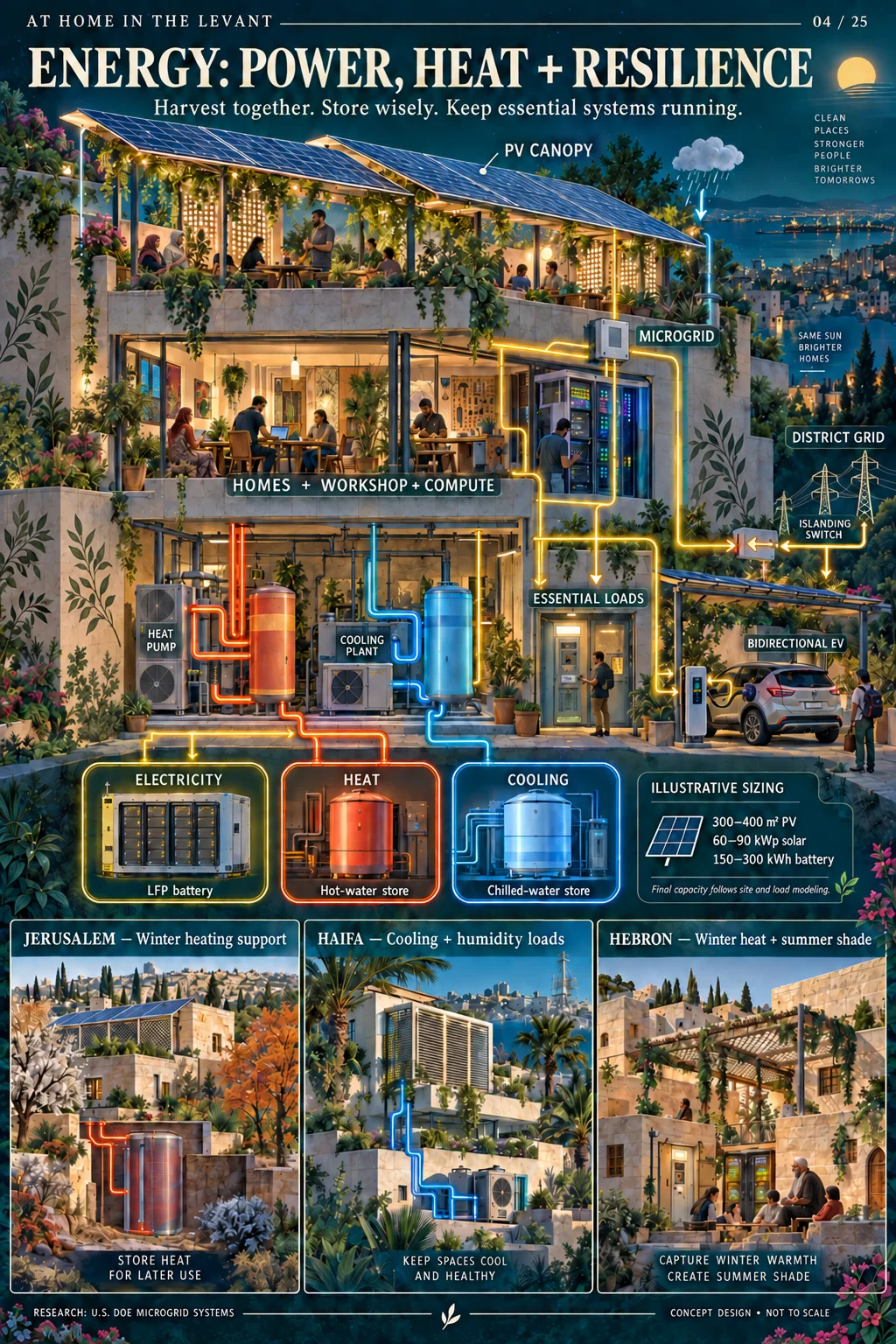
A photovoltaic canopy shades the roof and feeds a building microgrid. The microgrid talks to the district grid, and an islanding switch lets the building keep its essential loads running when the grid goes down. Heat pumps and a cooling plant serve the homes, the workshop, and the computers. A bidirectional car charger lets an electric car act as one more battery.
Energy gets stored in three forms, not one: electricity in an LFP battery, heat in a hot-water store, and cooling in a chilled-water store. Illustrative sizing is 300 to 400 square meters of panels, 60 to 90 kilowatts peak, and 150 to 300 kilowatt-hours of battery, with the final numbers set by real site and load modeling. Each city leans differently: Jerusalem stores heat for winter, Haifa fights cooling and humidity, Hebron needs winter heat and summer shade.
Questions, corrections, or a site where this could be built? Write to me.