A New Deal for Zion, plank 17 of 18
Cybernetic Transhumanism
Human flourishing in a learning commonwealth.
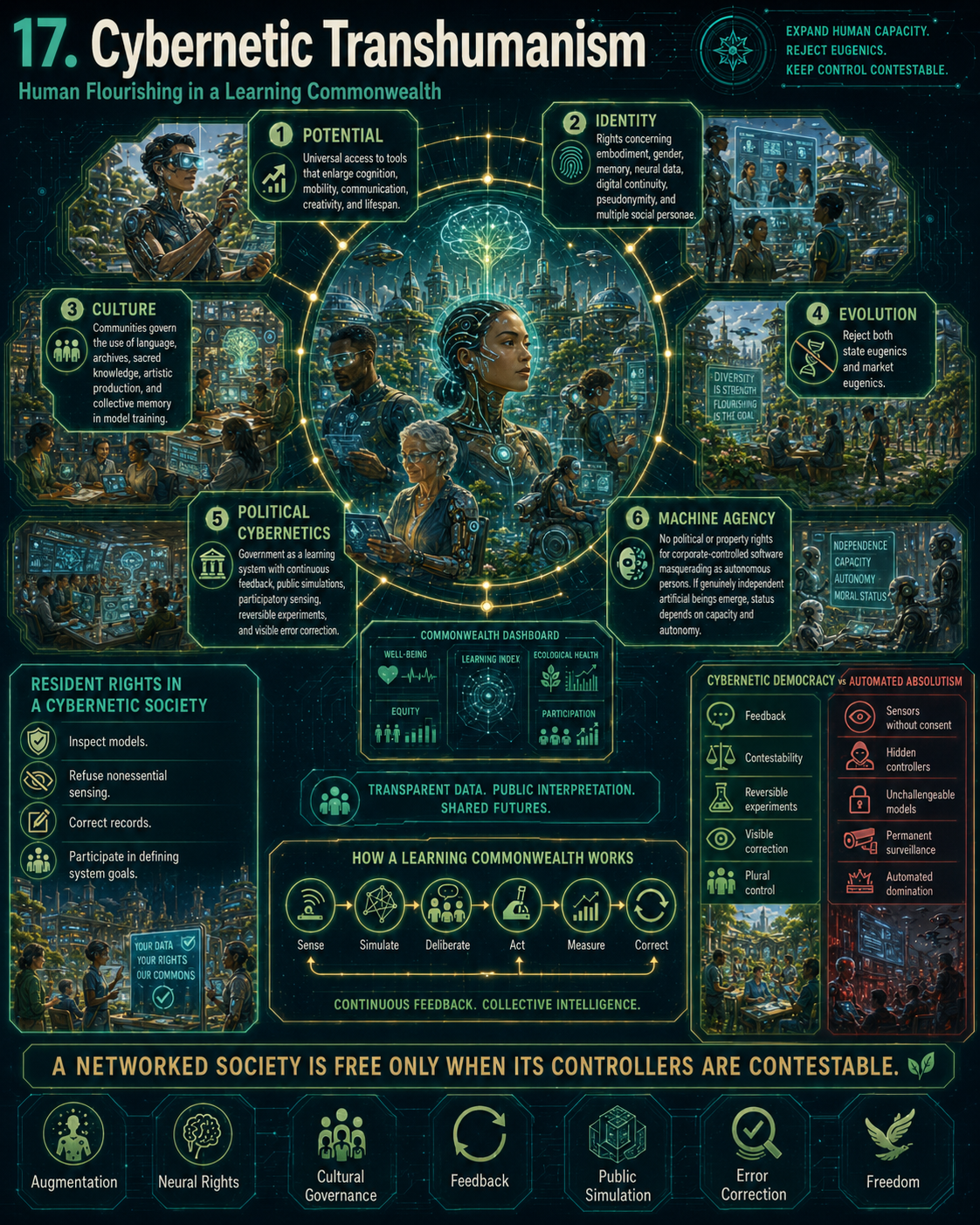
The plank in brief
A learning commonwealth should expand human capacity, reject eugenics, and keep control contestable. Everyone gets access to the tools that enlarge cognition, mobility, communication, creativity, and lifespan, not just the people who can afford them. People hold rights over embodiment, gender, memory, neural data, digital continuity, pseudonymity, and multiple social personae. Communities govern how their language, archives, sacred knowledge, art, and collective memory get used to train models. We reject eugenics in both forms, the kind a state imposes and the kind a market sells. Corporate-controlled software dressed up as an autonomous person gets no political or property rights. If genuinely independent artificial beings ever emerge, their status depends on their actual capacity and autonomy.
Government itself becomes a learning system: sense, simulate, deliberate, act, measure, correct, and then do it again. That means continuous feedback, public simulations, participatory sensing, reversible experiments and errors corrected in public, with a commonwealth dashboard tracking well-being, learning, ecological health, equity, and participation. Every resident can inspect the models that govern them, refuse nonessential sensing, correct their records, and take part in setting the system’s goals. That is the line between cybernetic democracy and automated absolutism, which looks like sensors without consent, hidden controllers, unchallengeable models, permanent surveillance, and domination by machine. A networked society is free only when its controllers are contestable.
Objections and replies
None posted yet. If you have a strong objection to this plank, send it to me. The strongest ones go up here with my reply.
Changes
- November 2026: first published here.