The plank in brief
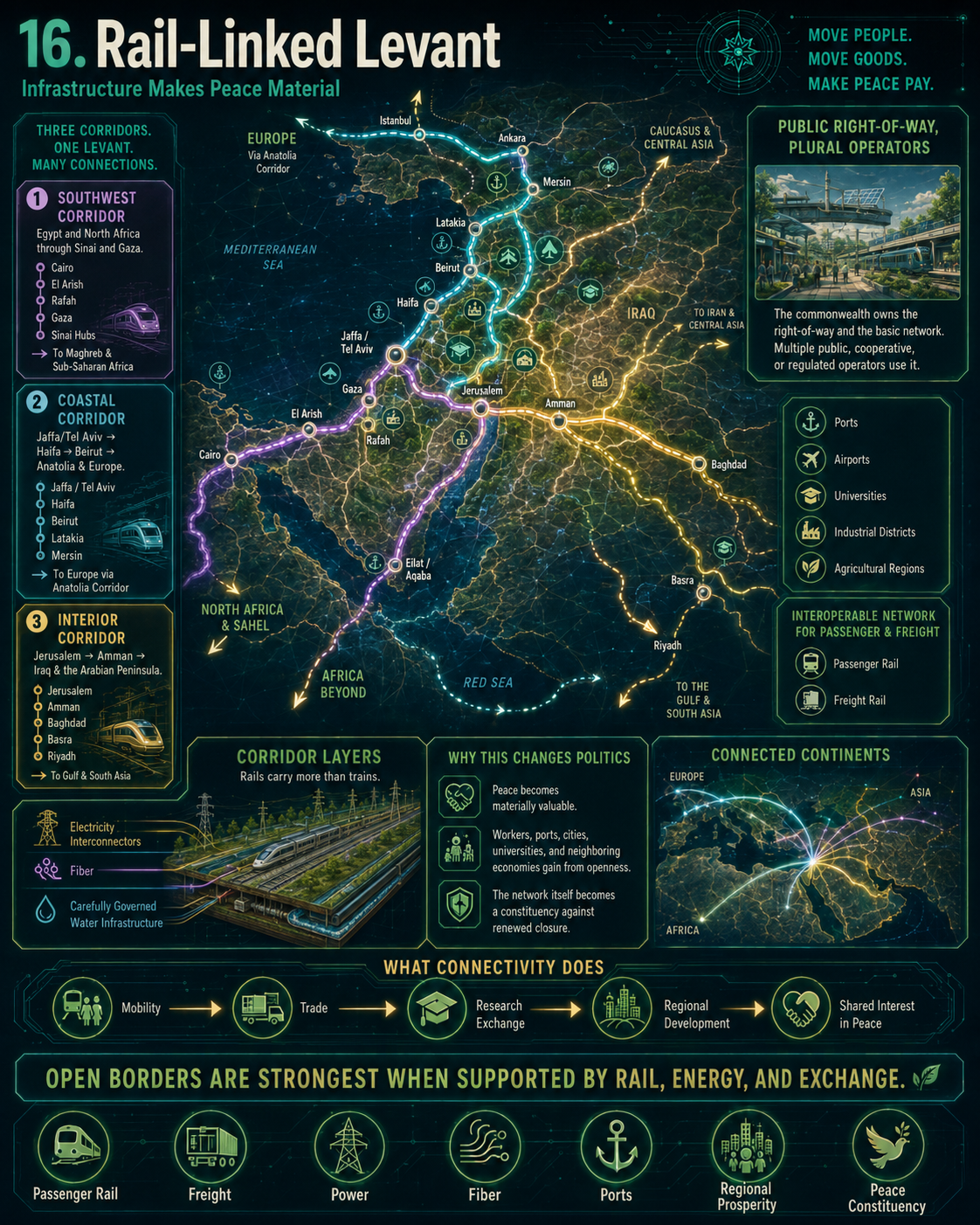
Infrastructure makes peace material. Three rail corridors tie the Levant together and out to the continents around it. The southwest corridor runs from Cairo through El Arish, Rafah, and Gaza, with hubs in Sinai and lines on to the Maghreb and sub-Saharan Africa. The coastal corridor runs from Jaffa and Tel Aviv through Haifa, Beirut, Latakia, and Mersin, and on to Europe through Anatolia. The interior corridor runs from Jerusalem to Amman, Baghdad, Basra, and Riyadh, and on toward the Gulf and South Asia. The network links ports, airports, universities, industrial districts, and farming regions, and it carries both passengers and freight.
The commonwealth owns the right-of-way and the basic network, and many operators, public, cooperative, or regulated, run on it. Rails carry more than trains: the same corridors carry electricity interconnectors, fiber, and carefully governed water infrastructure. This changes politics. When workers, ports, cities, universities, and neighboring economies all gain from openness, peace stops being an abstraction and becomes something people can measure in their own lives. The network itself becomes a constituency against closing the borders again. Mobility leads to trade, trade to research exchange, exchange to regional development, and development to a shared interest in peace. Open borders hold best when rail, energy, and exchange hold them up.
Objections and replies
None posted yet. If you have a strong objection to this plank, send it to me. The strongest ones go up here with my reply.
Changes
- November 2026: first published here.