A New Deal for Zion, plank 10 of 18
APIs as Constitutional Infrastructure
Digital public infrastructure for a distributed commonwealth.
The plank in brief
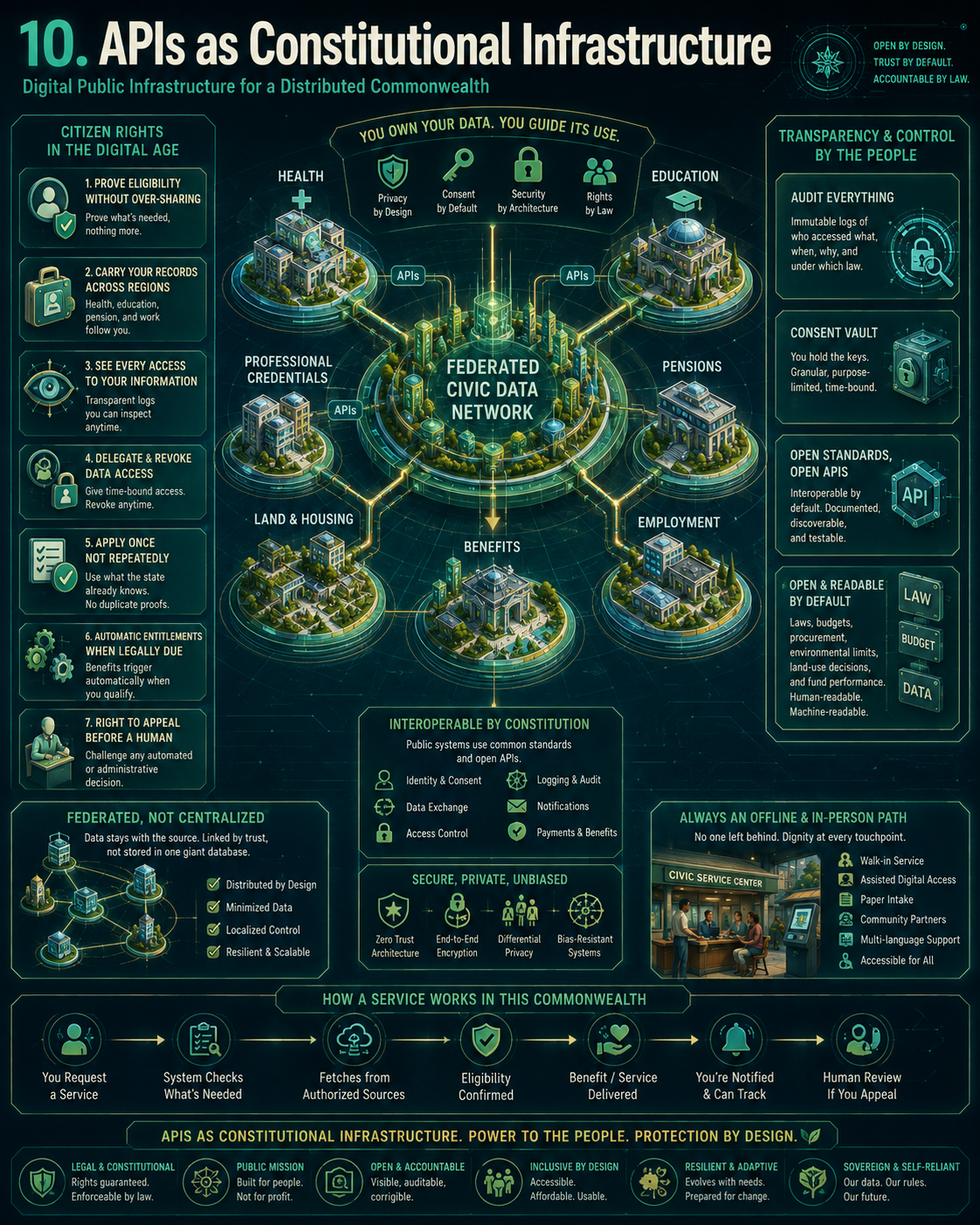
A distributed commonwealth runs on digital public infrastructure, and the rules for that infrastructure belong in the constitution, not in a vendor contract. You own your data and you guide its use: privacy by design, consent by default, security by architecture, rights by law. Health, education, professional credentials, pensions, land and housing, benefits, and employment connect through a federated civic data network. Data stays with its source and is linked by trust, not poured into one giant database. Every public system speaks common standards and open APIs for identity and consent, data exchange, access control, logging and audit, notifications and payments. Zero-trust architecture, end-to-end encryption, differential privacy, and bias-resistant systems are the baseline.
That gives every person concrete rights. You prove you’re eligible without over-sharing. Your records follow you across regions. You can see every access to your information in logs you can inspect, and grant time-bound access and revoke it whenever you want. You apply once, because the state uses what it already knows, and entitlements kick in automatically when you’re legally due them. You can appeal any automated or administrative decision to a human. In the other direction, everything is auditable: immutable logs of who accessed what, when, why and under which law, and laws, budgets, procurement, environmental limits, land-use decisions, and fund performance published in forms people and machines can both read. And there’s always an offline path: walk-in service centers, assisted digital access, paper intake, community partners, and support in many languages. Nobody gets left behind because they don’t have a smartphone.
Objections and replies
None posted yet. If you have a strong objection to this plank, send it to me. The strongest ones go up here with my reply.
Changes
- November 2026: first published here.